
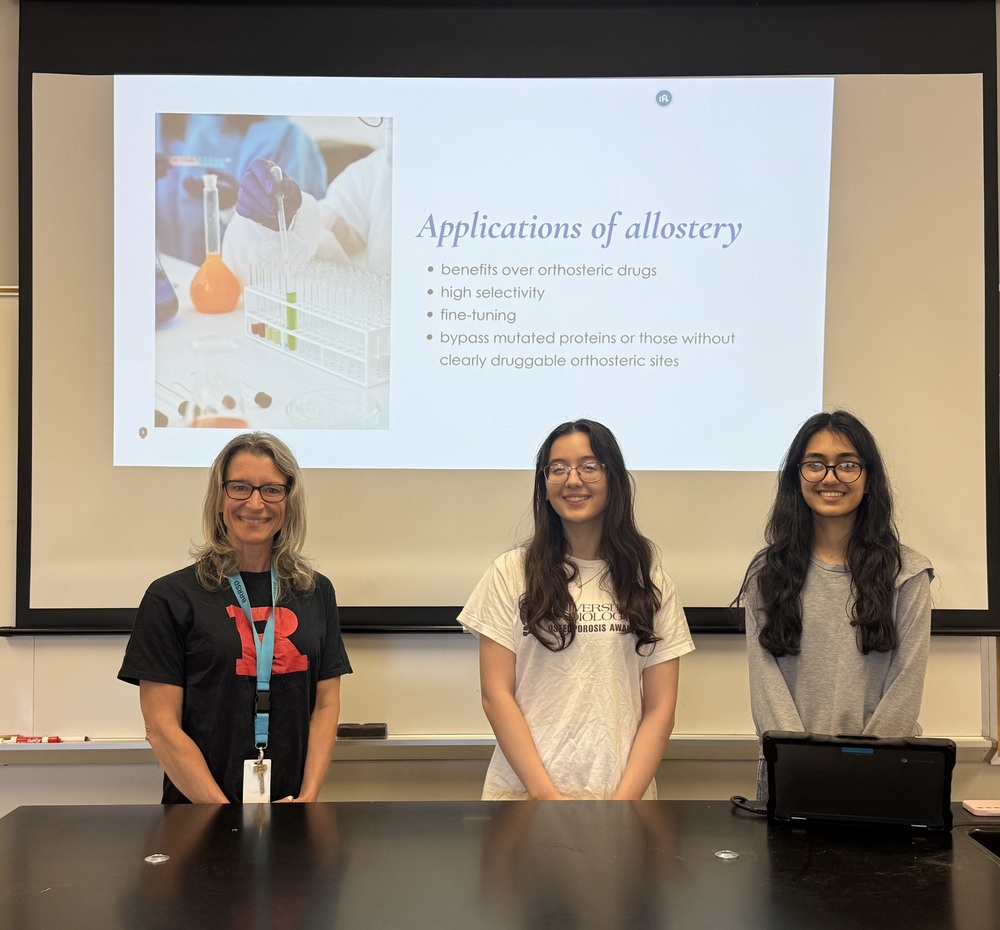
Dr. Cheryl Pieroni is a Science Teacher, among many other roles, at Bridgewater-Raritan High School.
So when she takes pleasure and satisfaction in seeing two of her students succeed in their research, she is also both proud and honored.
“It has been an honor to volunteer my time helping students explore scientific fields and topics that spark their curiosity. I have enjoyed sharing the knowledge and experiences I gained through my master's research and doctoral dissertation with the next generation of scientists and scholars,” Dr. Pieroni said.
At Bridgewater-Raritan High School, Dr. Pieroni also serves as the Science Coordinator, Science Bowl Team Coach, and Advisor for the Biology and Chemistry Olympiads.
She shared her experience teaching and advising her students.
“Over the years, students have designed and conducted their own scientific experiments, participated in summer research programs such as the WISE and THED programs at Rutgers, and independently explored peer-reviewed literature on topics of personal interest,” Dr. Pieroni said.
Now she is proud to speak of two Bridgewater-Raritan High School juniors—Chloe Amato and Tanvi Joshi—who completed their research and presented their topics during lunch on Tuesday, June 16.
Chloe’s topic was The validity of computational methods for novel allosteric inhibitor identification.
Her type of study: Computational/simulated, quantitative.
“Additionally, I have really enjoyed examining the literature around allosteric enzymes and learning about how our modern view of allostery was shaped by historical models like the MWC and KNF models. My literature review has allowed me to gain a deeper understanding of the mechanisms behind allosteric enzymes. I plan to continue my research over the summer and my interest in biochemistry by pursuing Dr. Pieroni's recommendation of participating in Rutgers THED, a summer program focused on laboratory skills, molecular biology, and toxicology,” Chloe presented.
Tanvi’s topic was The Role of Mobile Genetic Elements in the Dissemination of Antibiotic Resistance Genes in Hospital Wastewater.
Her type of study: Literature Review.
“ I have enjoyed doing my preliminary research on mobile genetic elements, especially because my AP Biology class does not cover these topics. The independent research study has allowed me to pursue my interest in healthcare and biology outside of the classroom, and I am excited to further my understanding of antibiotic resistance. Dr. Pieroni has given me guidance on how to structure my literature review to include more quantitative information and what graphics I can include. In the future, I will be participating in the Rutgers THED program to develop my laboratory skills and learn more about microbiology,” Tanvi reported.
“ Watching students develop their research skills, critical thinking, and passion for scientific discovery has been one of the most rewarding aspects of this experience,” Dr. Pieroni said.